
실험계획법을 이용한 연료전지 성능 향상에 관한 수치해석 연구
2026 The Korean Hydrogen and New Energy Society. All rights reserved.
Abstract
With the global acceleration of carbon neutrality initiatives, interest in Polymer Electrode Membrane Fuel Cells (PEMFCs) as a promising eco-friendly technology is rapidly growing. This study aims to enhance PEMFC performance by analyzing the effects of key design parameters-porosity, tortuosity, membrane thickness, and cathode catalyst loading-on performance using 1D simulation. First, parametric study was conducted to understand the impact of individual variations in each parameter on fuel cell performance. Subsequently, latin hypercube sampling and full factorial design methods were employed to successfully identify parameter points where fuel cell performance is optimized.
Keywords:
1D simulation, Design of Experiment, Performance enhancement, Polymer electrode membrane fuel cell, Membrane electrode assembly키워드:
1D 시뮬레이션, 실험계획법, 성능 향상, 고분자 전해질 연료전지, 막전극 집합체1. 서 론
전 세계적인 지구 온난화 및 이상 기후 현상의 심화에 따라 탄소 중립 정책이 강화되고 있다. 또한, 국내에서는 정부의 2050년 탄소 중립 시나리오1)가 발표되면서 전환, 수송, 산업, 건물, 농축 수산, 폐기물 부문에서 온실가스 감축을 위한 다양한 정책들이 추진되고 있다2). 이에 따라 많은 연구 기관이나 기업에서 친환경 기술에 대한 관심이 증가하고 있다. 탄소중립의 각 부문 중 수송과 전환 부문에서는 기존의 내연기관과 석탄 화력발전을 대체하기 위한 친환경적이면서도 고효율의 에너지 생산 능력을 가진 연료전지에 대한 연구가 활발히 진행되고 있다3-7). 연료전지는 연료에 저장된 화학적 에너지를 전기적 에너지로 변환하는 장치이다. 연료로부터 이동된 전자들은 외부 회로를 통해 이동하고, 전해질을 이용한 공간적 분리를 통해 전자의 이동을 차단하고 이온만이 전해질을 통과하게 된다8,9). 고분자 전해질 막 연료전지는 낮은 작동온도, 빠른 응답성, 높은 전력 밀도를 지니고 있어 자동차, 건설기계, 드론, 선박 등 다양한 시스템의 동력원으로 각광받고 있다10-12)
PEMFC는 수소와 산소의 전기화학 반응을 통해 전기 및 열에너지를 생산한다. PEMFC는 gasket, bipolar plate 등 많은 요소들13)로 이루어져 있으며, 시스템 성능과 내구성에 영향을 미치는 막전극 접합체14)(membrane electrode assembly, MEA)가 중요하다. MEA는 멤브레인막(membrane), 촉매층(catalyst layer), 가스 확산층(gas diffusion layer, GDL)으로 구성되어 있다. 주요 변수로는 멤브레인 두께, catalyst loading, porosity와 tortuosity가 있다.
Kim 등15)은 GDL porosity에 따른 GDL 내부에서의 반응 기체 전달, 열 배출의 변화로 인한 연료전지의 성능 변화를 3차원 수치해석 연구를 수행하였다. Current density가 낮은 구간에서는 porosity에 따른 연료전지의 성능 변화가 미미했지만, current density가 상대적으로 높은 영역에서는 porosity가 작을 경우 연료전지의 성능이 급격히 감소했다. Hwang 등16)은 멤브레인 두께가 연료전지 성능과 수명에 미치는 영향에 관한 연구를 수행하였다. 멤브레인 두께가 증가할수록 막 저항이 증가하여 연료전지 성능은 감소하지만, 수명은 증가한다. 성능과 수명을 동시에 만족시키는 멤브레인 두께는 25∼28 μm였다.
본 연구에서는 GT-SUITE (Gamma Technologies, West, IL, USA)를 사용하여 1D 수치해석을 통해 멤브레인 두께, catalyst loading (Lc), porosity, tortuosity를 변수로 선정해 각 변수의 변화에 따른 연료전지 성능 변화를 살펴본 후, 실험계획법(design of experiment, DoE)을 통해 각 변수들을 동시에 변화시켰을 때의 성능 변화 또한 살펴보고자 한다. 사용한 DoE 기법은 총 두 가지로, latin hypercube sampling (LHS) 기법과 full factorial design (FFD) 기법을 사용하였다.
2. 방법론
2.1 연료전지 모델
본 연구에서는 내부 실험을 통해 PEMFC 단전지의 I-V curve를 확보하였다. 연구의 실험적 검증을 위해 WonTech사의 Smart 2 연료전지 테스트 벤치를 이용하여 유효 면적 25 cm2의 단전지 성능 평가를 수행하였다. MEA의 멤브레인은 다공성 지지체에 과불소술폰산 아이오노머를 함침시킨 5중 코팅막을 적용하였으며, GDL로는 양극과 음극에 동일하게 300 μm 두께의 카본 페이퍼를 사용하였다. 촉매층은 백금-탄소 복합체가 균일하게 분포된 구조이며, 탄소 지지체로는 표면적 450 mg/cm2의 아세틸렌 블랙이 사용되었다. 실험 조건은 Table 1에 나타내었다. 시뮬레이션에 사용된 1D 단전지 모델은 Fig. 1에 나타내었다. Fig. 2는 수치해석 모델을 검증하기 위해 실험을 통해 얻은 데이터와 비교한 결과이다. Max. Power 기준 (@ current density 1.2 A/cm2) 2.62% 오차를 보였다. 실험과 시뮬레이션에 전체 current density에서 약 3% 이내의 낮은 오차 범위를 확인하였다.

Specifications of fuel cell model

Diagram of single fuel cell model

Polarization curves of experiment and simulation model
연료전지 셀의 이론적 전압은 식 [1]의 Nernst 방정식에 의해 계산되고, 이 전압에 식 [2]의 활성화 손실 전압(Vact), 식 [3]의 저항 손실 전압(VΩ), 식 [4]의 물질 전달 손실 전압(Vmt), open cell voltage (OCV) 내부 손실 전압(VdelOC)을 빼주면 식 [5]와 같이 연료전지의 셀 전압이 계산된다17-19).
| (1) |
| (2) |
| (3) |
| (4) |
| (5) |
2.2 Case setup
개별 변수 수치해석의 경우, membrane, catalyst layer, GDL의 주요 변수인 멤브레인 두께, Lc, porosity, tortuosity의 범위를 Table 2와 같이 설정했다. 멤브레인 두께는 10 μm, Lc는 0.2 mg/cm2, porosity는 0.05, tortuosity는 0.2의 간격으로 총 21개의 수치해석을 진행했다. 또한 개별 변수별 수치해석에서는 특정 변수의 변화에 따른 성능 변화를 고찰하기 위해, 분석 대상 변수를 제외한 나머지 세 가지 변수는 tortuosity 1.6, porosity 0.76, 멤브레인 두께 100 μm, Lc 1 mg/cm2 로 고정된 상태에서 수치해석을 진행했다.
Variables range of individual variables numerical analysis and LHS
멤브레인 두께가 증가하면 저항이 커져 ohmic loss가 증가하고 성능이 감소하지만, 내구성은 증가한다. Lc는 전극에 도포된 촉매의 양을 의미한다. Lc가 작으면 반응 면적이 줄어들어 activation loss가 증가하고 연료전지 성능이 감소한다. 촉매량이 늘어나면 성능은 증가하지만 비용도 동시에 증가하고, mass transport loss를 유발하여 오히려 성능이 감소될 수 있다. Porosity 는 GDL내 기공의 비율을 의미한다. Porosity가 클수록 기체의 확산이 원활해져 연료전지의 성능은 증가하지만, 그와 동시에 내구성 또한 감소한다. Tortuosity는 다공성 매질 내부 기공 통로의 복잡도를 의미하는 지표이다. Tortuosity가 1일 경우 직선 형태이고, 1보다 클 경우에는 통로가 구불구불하다는 것을 의미한다. Tortuosity가 증가할수록 물질 이동 속도가 느려지므로 연료전지 성능은 감소한다.
LHS는 fractional factorial design 기반의 DoE 기법이다. LHS는 각 변수에 지정한 범위를 균일하게 분할하고, 분할한 각 구간에서 하나의 샘플을 추출한다. 이로 인해 각 구간에서 모든 샘플을 추출하는 FFD 기법에 비해 해석의 수렴 속도가 빠르다는 장점이 존재한다20).
FFD는 변수마다 범위를 지정해주고, 지정된 범위 내의 모든 변수의 조합을 나열하는 기법이다. FFD의 가장 큰 장점은 모든 변수들의 조합을 나열하기 때문에 해석의 정확도가 높다는 점이다21). 본 연구에서는 LHS 320 points, FFD는 343 points를 지정하여 전류밀도 0.9 A/cm2 구간에서 해석을 진행하였다. LHS는 개별 변수 수치해석에 사용된 변수 범위를 동일하게 적용했고, FFD의 변수와 범위는 Table 3에 정리했다.
Variables range of full factorial design
3. 결과 및 고찰
3.1 변수별 영향 분석
Fig. 3은 porosity를 0.65부터 0.85까지 0.5간격으로 변화시켰을 때의 I-V curve이다. Porosity가 증가할수록 고전류 밀도 영역에서 전압이 증가하는 경향을 확인하였다. Porosity가 증가하면 GDL에서 catalyst로의 물질 전달이 향상됨에 따라 연료전지 내부의 반응이 활발해진다. 이 과정에서 mass transport loss가 감소하여 연료전지의 성능이 향상된다.

Effects of porosity on I-V curves
Fig. 4는 tortuosity를 1에서 2까지 0.2 간격으로 변화시켰을 때의 I-V curve이다. Porosity와 반대로 tortuosity가 증가할수록 I-V curve의 고전류 밀도 영역에서 전압이 급격하게 감소하는 경향을 확인하였다. 이러한 경향이 나타난 원인 또한 mass transport loss와 관련이 있다. Tortuosity가 증가할수록 GDL에서의 확산 속도가 감소하고, 촉매층으로 충분한 반응물이 공급되지 않아 반응물 농도가 떨어져 mass transport loss가 증가하여 연료전지의 성능이 감소한다.
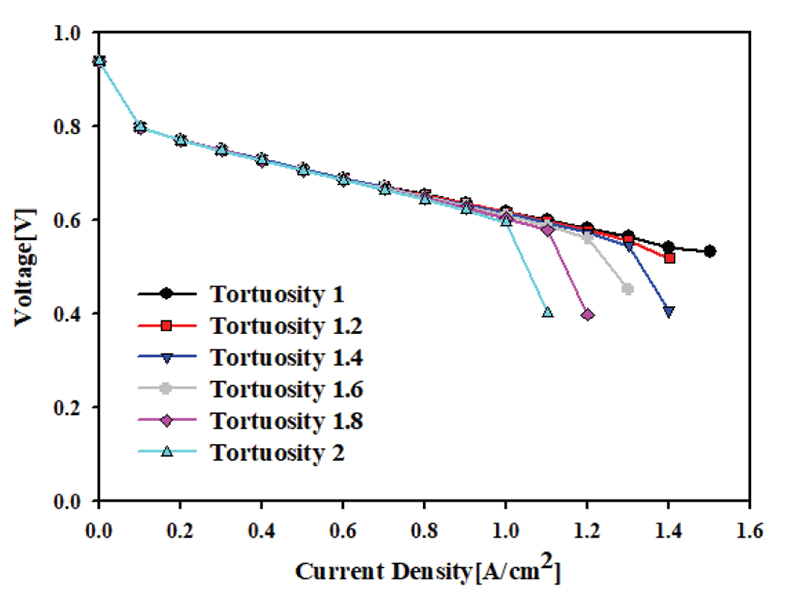
Effects of tortuosity on I-V curves
Fig. 5는 멤브레인 두께를 80 μm에서 120 μm까지 10 μm 간격으로 증가시켰을 때의 I-V curve이다. Tortuosity와 마찬가지로 멤브레인 두께가 증가할수록 I-V curve의 전압이 감소하는 경향을 보이고 있다. 하지만 tortuosity의 증가로 인한 전압 감소와는 그 원인이 다르다. 연료전지가 전기를 생산하는 과정에서 이온은 멤브레인을 통과하여 한 전극에서 반대 전극으로 이동한다. 이때 멤브레인은 전해질로 구성되어 있어 이온은 통과하고 전자는 차단하는 역할을 한다. 멤브레인 내부로 이온이 통과하면서 ohmic loss가 발생하고, 옴의 법칙에 따라 멤브레인이 두꺼워지면 저항 손실 전압이 증가하여 연료전지의 성능이 감소한다.

Effects of membrane thickness on I-V curves

3.2 실험계획법을 이용한 분석
모든 변수를 LHS를 사용하여 시뮬레이션을 수행한 결과 총 320개의 case를 산출하였으며, 해당 그래프를 Fig. 7에 나타냈다. 산출된 결과 중에는 기준 전압인 0.6303 V보다 월등히 높은 전압을 보이는 case들도 다수 존재하였으나, 0.64 V를 초과하는 case들의 경우 각 설계 변수들이 극단적인 값으로 조합되어 있어 실제 연료전지 시스템 제작에 적용하기에는 물리적 무리가 있을 것으로 판단하였다. 따라서 실제 제작 및 시스템 적용 가능성을 우선으로 고려하여 0.64 V 이하의 현실적인 성능 향상 구간에서 특징적인 case (case A, case B, case C)를 선정하였으며, 해당 case의 I-V curve와 I-P curve를 Fig. 8에, 각각의 제원을 Table 4에 나타내었다.

Distribution of output cases of LHS

I-V and I-P curves of LHS cases
Specifications for each case derived from LHS
Case A의 경우 초기 모델보다 porosity, tortuosity는 감소하고 Lc와 멤브레인 두께는 증가했다. 각 변수들은 mass transport loss, ohmic loss, activation loss에 영향을 미친다. 총 전압 손실은 감소하여 초기 모델 대비 max power가 약 3% 상승하였다. Case B는 초기 모델 대비 porosity, Lc, 멤브레인 두께는 증가, tortuosity는 감소했고, 초기 모델 대비 max power가 약 10.6% 상승했다.
Case C의 경우 초기 모델 대비 porosity, tortuosity는 감소, Lc, 멤브레인 두께는 증가했다. 초기 모델 대비 max power가 약 5% 상승했다. 3가지 case들 모두 멤브레인 두께가 증가하여 ohmic loss가 증가하는 경향을 보이지만, 다른 변수들의 변화로 인해 기존 모델 대비 성능이 향상되었다. 특히 초기모델 대비 max power가 10.6% 향상된 case B는 다른 case와 비교하여 tortuosity가 가장 크게 감소했다. 이는 tortuosity의 감소가 mass transport loss를 감소시켜 연료전지의 성능을 가장 효과적으로 향상시켰음을 의미한다.
Tortuosity를 1.6으로 고정하고, 나머지 변수인 porosity, 멤브레인 두께, Lc를 FFD 기법으로 시뮬레이션을 수행한 결과 총 343개의 case를 산출하였으며, 해당 그래프를 Fig. 9에 나타냈다. 앞선 LHS 기법에서의 선정 기준과 마찬가지로, 변수들의 극단적인 조합으로 인하여 실제 연료전지와의 적용성이 떨어지는 경우를 배제하고자 하였다. 이에 따라 초기 전압 0.6303 V를 중심으로 실제 적용이 가능한 0.62 V에서 0.64 V 사이의 구간을 유효 구간으로 설정하였다. 해당 구간 내에서 변수들의 상호작용에 따른 성능 증감 경향을 폭넓게 비교하기 위해 대표적인 4가지 case (case A, case B, case C, case D)를 선정하여 해당 case들의 I-V curve와 I-P curve를 Fig. 10에, 각각의 제원을 Table 5에 나타냈다.

Distribution of output cases of FFD

I-V and I-P curves of FFD cases
Specifications for each case derived from FFD
Case A는 초기 모델보다 porosity는 감소, Lc는 유지, 멤브레인 두께는 증가했다. 초기 모델 대비 max power는 6.4% 감소하여 변수들의 변화가 총 전압손실을 증가시켰다는 것을 의미한다. Case B는 porosity는 감소, Lc, 멤브레인 두께는 증가했고 초기 모델 대비 max power가 약 2.2% 감소했다. Case C는 초기 모델보다 porosity는 증가, Lc는 유지, 멤브레인 두께는 감소했고, 초기 모델 대비 max power가 약 1.6% 상승했다. 초기 모델 대비 max power의 상승폭이 2.7%로 가장 컸던 case D의 경우 porosity, Lc는 증가, 멤브레인 두께는 유지됐다.
4. 결 론
본 연구에서는 GT-SUITE을 사용하여 개별 변수 수치해석, latin hypercube sampling, full factorial design을 통해 MEA의 변수인 porosity, tortuosity, 멤브레인 두께, catalyst loading이 연료전지 성능에 미치는 영향을 분석하였다. Parametric study를 통해 porosity와 catalyst loading은 증가할수록, tortuosity와 멤브레인 두께는 감소할수록 연료전지의 성능이 향상되는 것을 확인했다. LHS를 통한 수치해석 결과, 4가지의 변수 중 tortuosity가 연료전지의 성능에 가장 결정적인 영향을 미치는 것으로 나타났다. FFD를 이용하여 시뮬레이션을 진행한 결과 porosity가 catalyst loading과 멤브레인 두께보다 연료전지 성능에 미치는 영향이 더 두드러지는 경향을 보였다. 향후 연구에서는 LHS 및 FFD 분석 결과를 토대로, 변수 간의 상호작용 효과를 심층적으로 분석해 보겠다.
- 1) Porosity가 증가하거나 tortuosity가 감소하면 mass transport loss가 감소하여 연료전지의 성능이 향상된다.
- 2) 멤브레인 두께가 증가하면 ohmic loss가 증가하여 연료전지의 성능이 저하된다.
- 3) Catalyst loading이 증가하면 activation loss가 감소하여 연료전지의 성능이 향상된다.
- 4) LHS 기법을 적용한 결과, 단순한 이론적 최대 성능이 아닌 실제 MEA 제조 공정에 적용 가능한 현실적 변수 범위 내에서 최적의 조합을 도출하였다. 극단적인 변수 조합에 의한 한계를 배제한 유효 전압 구간을 분석했을 때, tortuosity의 감소가 mass transport loss를 획기적으로 저감시켜 연료전지의 최대 출력을 약 10.6% 향상시키는 가장 지배적인 인자임을 규명하였다.
- 5) FFD 기법을 통해 tortuosity를 고정한 상태에서 porosity, catalyst loading, 멤브레인 두께의 상호작용을 분석한 결과 기공도의 최적화가 catalyst loading이나 멤브레인 두께의 조절보다 선응에 미치는 영향이 더욱 두드러짐을 확인하였으며, 실제 적용 가능한 전압 범위 내에서 최대 2.7%의 성능 상승을 달성하였다.
⠀
| Abbreviations | |
|---|---|
| PEMFC : | Polymer electrode membrane fuel cell |
| MEA : | Membrane electrode assembly |
| GDL : | Gas diffusion layer |
| LHS : | Latin hypercube sampling |
| FFD : | Full factorial design |
| Lc : | Catalyst loading |
| Symbols | |
|---|---|
| : | 깁스 자유에너지 |
| F : | 패러데이 상수 |
| α : | 전하 전달 계수 |
| i, i0 : | 작동 전류 밀도, 교환 전류 밀도 |
| tm : | 멤브레인 두께 |
| σm : | 멤브레인 전도도 |
| Deff : | 유효 확산 계수 |
| ϵ : | 기공도 |
Acknowledgments
이 논문은 조선대학교 연구지원금의 지원을 받아 연구되었음(2023).
References
- 2050 Carbon Neutrality and Green Growth Commission, “Data on the policy of 2050 carbon neutrality scenario”, 2050 Carbon Neutrality and Green Growth Commission, 2021, Retrieved from https://www.2050cnc.go.kr/base/board/read?boardManagementNo=4&boardNo=101&searchCategory=&page=1&searchType=&searchWord=&menuLevel=2&menuNo=15, .
- H. I. Lee, “A study on carbon reduction strategies in the construction industry”, Construction Economy Research Insitute of Korea, 2022, Retrieved from https://www.cerik.re.kr/eng/report/research/2666, .
-
S. Chakraborty, D. Elangovan, K. Palaniswamy, A. Fly, D. Ravi, D. A. S. Seelan, and T. K. R. Rajagopal, “A review on the numerical studies on the performance of proton exchange membrane fuel cell (PEMFC) flow channel designs for automotive applications”, Energies, Vol. 15, No. 24, 2022, pp. 9520.
[https://doi.org/10.3390/en15249520]

-
T. Zhang, P. Wang, H. Chen, and P. Pei, “A review of automotive proton exchange membrane fuel cell degradation under start-stop operating condition”, Applied Energy, Vol. 223, 2018, pp. 249-262.
[https://doi.org/10.1016/j.apenergy.2018.04.049]
-
J. Park, C. Kim, S. Park, and Y. Kim, “Performance analysis on the zigzag turn angle of PEMFC cathode serpentine flow path”, Journal of Hydrogen and New Energy, Vol. 36, No. 3, 2025, pp. 239-248.
[https://doi.org/10.7316/jhne.2025.36.3.239]
-
C. Kim, J. Son, S. Park, J. Park, and Y. B. Kim, “Analysis of flow distribution and performance of variable relative humidity condition in PEMFC with micro porous layer”, Journal of Hydrogen and New Energy, Vol. 36, No. 3, 2025, pp. 249-258.
[https://doi.org/10.7316/jhne.2025.36.3.249]
-
N. Son, M. Naseem, U. Kim, and Y. D. Lee, “Dynamic simulation of proton exchange membrane fuel cell stack under various operating pattern of fuel cell powered heavy duty truck”, Journal of Hydrogen and New Energy, Vol. 35, No. 2, 2024, pp. 121-128.
[https://doi.org/10.7316/JHNE.2024.35.2.121]
-
Y. Wang, D. F. Ruiz Diaz, K. S. Chen, Z. Wang, and X. C. Adroher, “Materials, technological status, and fundamentals of PEM fuel cells - a review”, Materials Today, Vol. 32, 2020, pp. 178-203.
[https://doi.org/10.1016/j.mattod.2019.06.005]
-
O. Z. Sharaf and M. F. Orhan, “An overview of fuel cell technology: fundamentals and applications”, Renewable and Sustainable Energy Reviews, Vol. 32, 2014, pp. 810-853.
[https://doi.org/10.1016/j.rser.2014.01.012]
-
H. Ryu, W. Yoon, S. Lee, J. Hwang, J. Oh, J. Park, and H. S. Kim, “A study on power distribution strategy between fuel cell and battery for 50 kW construction equipment using 1D simulation”, Journal of Hydrogen and New Energy, Vol. 35, No. 6, 2024, pp. 706-714.
[https://doi.org/10.7316/jhne.2024.35.6.706]
-
P. Shuhayeu, A. Martsinchyk, K. Martsinchyk, and J. Milewski, “Investigating PEM fuel cells as an alternative power source for electric UAVs: modeling, optimization, and performance analysis”, Energies, Vol. 17, No. 17, 2024, pp. 4427.
[https://doi.org/10.3390/en17174427]
-
A. G. Elkafas, M. Rivarolo, E. Gadducci, L. Magistri, and A. F. Massardo, “Fuel cell systems for maritime: a review of research development, commercial products, applications, and perspectives”, Processes, Vol. 11, No. 1, 2023, pp. 97.
[https://doi.org/10.3390/pr11010097]
-
Y. Zhang, J. Wang, and Z. Yao, “Recent development of fuel cell core components and key materials: a review”, Energies, Vol. 16, No. 5, 2023, pp. 2099.
[https://doi.org/10.3390/en16052099]
-
L. Xing, W. Shi, H. Su, Q. Xu, P. K. Das, B. Mao, and K. Scott, “Membrane electrode assemblies for PEM fuel cells: a review of functional graded design and optimization”, Energy, Vol. 177, 2019, pp. 445-464.
[https://doi.org/10.1016/j.energy.2019.04.084]
-
K. Y. Kim, Y. J. Sohn, M. J. Kim, and W. Y. Lee, “Numerical study on the effects of GDL porosity on the PEMFC performance”, Transactions of the Korean Society of Mechanical Engineers B, Vol. 33, No. 12, 2009, pp. 1022-1030.
[https://doi.org/10.3795/ksme-b.2009.33.12.1022]
-
B. Hwang, H. Lee, and K. Park, “The effect of membrane thickness on durability and performance of proton exchange membrane fuel cell”, Korean Chemical Engineering Research, Vol. 55, No. 4, 2017, pp. 473-477.
[https://doi.org/10.9713/KCER.2017.55.4.473]
-
R. L. Edwards and A. Demuren, “Interface model of PEM fuel cell membrane steady-state behavior”, International Journal of Energy and Environmental Engineering, Vol. 10, No. 1, 2019, pp. 85-106.
[https://doi.org/10.1007/s40095-018-0288-2]
-
D. Murschenhofer, D. Kuzdas, S. Braun, and S. Jakubek, “A real-time capable quasi-2D proton exchange membrane fuel cell model”, Energy Conversion and Management, Vol. 162, 2018, pp. 159-175.
[https://doi.org/10.1016/j.enconman.2018.02.028]
-
T. E. Springer, T. A. Zawodzinski, and S. Gottesfeld, “Polymer electrolyte fuel cell model”, Journal of the Electrochemical Society, Vol. 138, No. 8, 1991, pp. 2334-2342.
[https://doi.org/10.1149/1.2085971]
-
R. Sheikholeslami and S. Razavi, “Progressive Latin hypercube sampling: an efficient approach for robust sampling-based analysis of environmental models”, Environmental Modelling & Software, Vol. 93, 2017, pp. 109-126.
[https://doi.org/10.1016/j.envsoft.2017.03.010]
-
L. M. Collins, J. J. Dziak, K. C. Kugler, and J. B. Trail, “Factorial experiments: efficient tools for evaluation of intervention components”, American Journal of Preventive Medicine, Vol. 47, No. 4, 2014, pp. 498-504.
[https://doi.org/10.1016/j.amepre.2014.06.021]