
A Study on the Legal and Institutional Analysis and Application of Regulatory Exemptions for the Maritime Demonstration of Liquid Hydrogen Transport Test Ships
2025 The Korean Hydrogen and New Energy Society. All rights reserved.
Abstract
Liquid hydrogen is emerging as a key clean marine fuel due to its high energy density, but its cryogenic characteristics and high flammability raise complex legal and safety challenges. This study examines the applicability of current Korean laws to the real-sea demonstration of liquid hydrogen transport test vessels, focusing on land, port, and maritime regulations. The analysis identifies legal blind spots, such as the lack of clear standards for temporary bunkering systems, and overlaps in administrative responsibilities across regulatory domains. To address these issues, the study proposes a tailored application of regulatory sandbox systems -both project-type and zone-type- to enable safe, lawful demonstrations. Based on this approach, specific procedures for exemption applications and safety conditions are presented. These results highlight the urgent need for an integrated legal framework and serve as a basis for institutional reform to support future commercialization of hydrogen-powered maritime transport.
Keywords:
Liquid hydrogen, Test vessel, Regulatory sandbox, Legal gap, Hydrogen bunkering키워드:
액체수소, 시험선, 규제 특례, 법령 공백, 수소 벙커링1. Introduction
As carbon neutrality and energy transition have emerged as major global policy agendas, hydrogen energy is gaining attention as a next-generation clean energy source1). Hydrogen emits no carbon dioxide when combusted and can be flexibly applied to large-scale energy systems through various production and storage methods, positioning it as a key pillar of future energy systems. In particular, liquid hydrogen, with an energy density approximately 800 times higher than gaseous hydrogen by volume, offers significant advantages for large-scale and long-distance maritime transportation. These characteristics further highlight the need for liquid hydrogen transportation technologies as essential infrastructure for the global hydrogen supply chain.
Against this backdrop, liquid hydrogen transport demonstration vessels play a critical role in verifying the safety and reliability of new storage and transportation technologies under real-sea conditions2). Liquid hydrogen must be stored at cryogenic temperatures (-253℃) and even minor leaks can pose significant explosion risks, requiring a level of risk management far beyond that of existing liquefied natural gas (LNG) carriers. Therefore, in addition to technical verification, the preparation and improvement of legal and institutional frameworks must also precede commercialization efforts3,4).
Currently, domestic regulations such as the High-Pressure Gas Safety Control Act, the Ship Act, the Ship Safety Act, and the Harbor Act provide a regulatory framework for ships and gas transportation. However, detailed regulations specifically targeting liquid hydrogen transport vessels remain insufficient5). Although the Hydrogen Economy Promotion and Hydrogen Safety Management Act has been enacted, it primarily focuses on land-based hydrogen infrastructure and has limitations when applied to maritime transportation demonstrations6). In particular, issues such as procedures for loading/unloading and bunkering, ensuring operational safety, establishing emergency response systems, and clarifying liability in case of accidents present potential regulatory gaps and conflicts.
To address these challenges, it is necessary to utilize the regulatory sandbox system to grant demonstration exemptions and subsequently revise relevant laws based on the demonstration data7). The regulatory sandbox allows new technologies and industries to proactively respond to existing legal frameworks by granting temporary regulatory exemptions. Specifically, it operates under two categories: project-based and zone-based. As each type has different application methods and legal characteristics, careful selection of the appropriate approach is essential for demonstration projects8).
This study aims to comprehensively analyze the current domestic legal and institutional framework for the operational deployment of liquid hydrogen demonstration vessels, propose procedures for applying regulatory exemptions and setting demonstration conditions, and suggest directions for clarifying liability and subsequent legislative improvements. In particular, the study seeks to preemptively address anticipated safety and environmental issues during the demonstration phase and present comprehensive policy recommendations that extend to institutionalization after the completion of the demonstration.
2. Methodology
2.1 Scope and subject of analysis
This study analyzes the domestic legal and institutional frameworks applicable to the demonstration of a liquid hydrogen transport test ship. The analysis is structured across three domains (land, port, and sea), focusing on key laws such as the High-Pressure Gas Safety Control Act, Hydrogen Economy Promotion and Hydrogen Safety Management Act, Harbor Act, Harbor Authority Act, Ship Act, Ship Safety Act, and Maritime Traffic Safety Act9). Fig. 1 outlines the major activities in each domain, such as mobile storage and tank lorry operations (land), bunkering and facility installation (port), and sea trials (sea), and maps the corresponding legal frameworks applied to each stage.
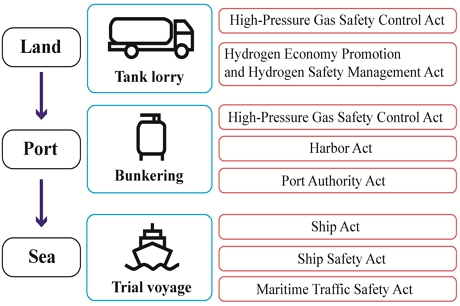
Legal and regulatory domains across the demonstration phases of a liquid hydrogen transport test ship
The study also examines the applicability of regulatory exemption systems to identify potential pathways for temporary regulatory relief during the demonstration. The scope is limited to the pre-commercial phase, with a focus on identifying key institutional prerequisites for safe and lawful execution.
2.2 Legal analysis method
To identify the structural characteristics of relevant laws, a provision-level analysis was conducted, focusing on the purpose, definitions, scope of application, and regulatory requirements of each statute. This allowed the study to distinguish between provisions applicable to the demonstration of the test ship and those that are not, thereby assessing both the legal validity and potential limitations of their application10).
The analysis categorized legal applicability according to the distinct phases of the transportation process: land, port, and sea. It also identified cases where multiple laws overlap or conflict in regulating the same activities. Particular attention was given to key processes such as storage and loading during land transport, bunkering and cargo handling within ports, and ship operation during maritime transport. Based on these, the study examined potential areas of zero coverage and regulatory conflict.
For areas lacking clear legal provisions, the analysis extended beyond simple interpretation of individual articles to a comprehensive review of inter-law relationships. This approach was intended to propose directions for institutional improvements and to minimize legal risks in the implementation of liquid hydrogen test ship demonstrations.
2.3 Approach to analyzing regulatory exemption system
This study conducted a structured review of key regulatory exemption laws to support the demonstration of a liquid hydrogen transport test ship. These include the Industrial Convergence Promotion Act and Special Act on Regulation-Free Zones8). The analysis focused on exemption eligibility, applicable technologies, application procedures, and review and approval processes.
Special emphasis was placed on comparing project-based and zone-based exemption models to determine which is better suited for technology demonstration activities. Safety requirements, data submission obligations, and post-approval conditions were also examined to define criteria for applying exemptions during test ship operations.
Additionally, the study assessed the compatibility of these exemption systems with existing legal frameworks, identifying potential overlaps, gaps, and conflicts. Based on this analysis, practical application strategies were proposed to ensure lawful and consistent implementation of regulatory exemptions in the demonstration phase.
2.4 Procedure for deriving institutional improvements
The development of institutional improvement measures was designed not merely as a revision of legal provisions, but as a strategy to minimize legal uncertainties during the demonstration process and ensure consistency in administrative procedures. In cases where the required activities for test ship demonstrations fall outside the scope of existing laws or lack clear regulation, the study proposes supplementary measures that include both legal amendments and coordinated application of regulatory exemptions. The prioritization of improvement measures was based on three key criteria: ensuring safety, maintaining legal clarity, and securing the practical feasibility of technology demonstrations11). Safety serves as a prerequisite for protecting public life, health, and the environment. Legal clarity underpins consistent administrative enforcement and industry acceptance. Feasibility ensures that demonstration activities can proceed without regulatory obstruction.
3. Relevant laws and systems
3.1 Land domain
The High-Pressure Gas Safety Control Act regulates the full lifecycle of designated high-pressure gases, including liquid hydrogen12). Under Articles 2 and 3, facilities such as storage sites and pipelines fall under its jurisdiction, with key provisions including Article 4 (Manufacturing Permission), Article 17 (Container Inspection), and Article 22-2 (Detailed Standards). The law primarily targets permanent installations, creating ambiguity when applied to temporary or mobile facilities for demonstration. Articles 9 (Revocation of Permission or Registration) and Article 16 (Inspections) may not be suitable for short-term operations. Furthermore, the Act does not account for the cryogenic nature of liquid hydrogen or boil-off gas (BOG) handling, and lacks clarity on liability in multi-party transfer scenarios. Legal revisions are needed to address these gaps for test ship applications.
The Hydrogen Economy Promotion and Hydrogen Safety Management Act aims to promote the hydrogen industry and ensure safety across the hydrogen lifecycle13). While it provides standards for land-based infrastructure and compressed hydrogen systems, it does not address the specific properties of liquid hydrogen or maritime applications.
Article 2 defines key hydrogen-related terms, but excludes liquid hydrogen and marine refueling. Article 5 (Formulation of Master Plans for Hydrogen Economy Implementation), Article 27 (Standardization of Hydrogen-Related Products), Article 53 (Data Submission and Inspection), and Article 56 (Delegation or Entrustment of Authority) may be partially relevant to demonstration vessels. Components such as tanks and safety devices may fall under the law's scope, but cryogenic features and BOG management are not covered. The law also lacks clarity on administrative responsibilities in maritime settings, raising concerns about fragmented oversight and the need for institutional refinement.
3.2 Port domain
The Harbor Act governs the development, use, and management of port facilities14). While Article 2 defines key port-related terms, it does not include hydrogen or liquid hydrogen. Relevant provisions for demonstration activities include Article 5 (Formulation of Harbor Master Plans), Article 17 (Prohibition of Use of Non-Vested Land and Harbor Facilities for other than Their Original Purposes), Article 28 (Prohibited Activities), and Article 41 (Use of Harbor Facilities). The lack of explicit reference to liquid hydrogen creates legal ambiguity. Temporary demonstration facilities may conflict with existing provisions intended for permanent infrastructure, and projects outside official port plans may face permitting challenges.
The Port Authority Act designates port authorities to manage port facilities under Article 1 and Article 2, but it lacks definitions related to hydrogen or energy infrastructure. Relevant provisions including Article 8 (Business), Article 21 (Implementation of Port Facility Construction), Article 29 (Lease of Port Facilities) and Article 30 (Collection of Usage Fees and Rental Fees) may provide a basis for limited demonstration activities15). However, the Act primarily addresses permanent facilities and does not explicitly accommodate temporary or collaborative demonstration projects. This creates potential legal uncertainty and may lead to overlapping jurisdiction with other maritime regulations.
3.3 Sea domain
The Ship Act provides the legal foundation for ship registration, nationality, and inspection. According to Article 2, even a test ship used temporarily for demonstration is classified as a “ship” and must comply with related procedures, including Article 8 (Registry and Registration), Article 13 (International Tonnage Certificate, etc.), article 26 (Ships Partially Excluded from Application) and Article 29 (Application Mutatis Mutandis of the Commercial Act)16). The Act is based on conventional commercial vessels and lacks specific provisions for liquid hydrogen-fueled demonstration ships. The absence of flexible or simplified procedures for temporary operations further limits regulatory adaptability, potentially increasing administrative burdens and uncertainty for test ship demonstrations.
The Ship Safety Act sets safety standards for ship structure and operation (Article 1) and classifies vessel types (Article 2), allowing liquid hydrogen test ships to be treated as hazardous cargo carriers17). Key provisions include Article 3 (Scope of Application), and Article 68 (Port State Control). Chapter 2 outlines the inspection and approval procedures. The Act lacks specific standards for cryogenic liquid hydrogen systems. While Articles 40 and 41 may be applied by analogy, existing guidelines focus on gaseous hydrogen or LNG. Evaluation criteria for temporary equipment are unclear, and international standards like the International Maritime Organization (IMO) IGC Code and International Organization for Standardization (ISO) 21013 are not yet fully integrated into domestic law.
The Maritime Traffic Safety Act governs safety in maritime activities (Article 1, Article 2) and applies to demonstration vessels as ships in navigation18). Chapter 2 (Safety Control at Sea) covers safety management, while Chapter 5 (Sea Traffic Control) includes provisions on accident prevention and emergency notifications. Although Article 7 allows for the designation of specific traffic safety zones, there are no specific references to liquid hydrogen vessels.
3.4 Analysis of legal conflicts and regulatory gaps
In the land domain, both the High-Pressure Gas Safety Control Act and the Hydrogen Economy Promotion and Hydrogen Safety Management Act apply to storage and transport systems. However, current standards are based on fixed installations, and there are no clear technical guidelines for mobile storage or temporary transfer systems. This results in interpretation gaps and regulatory redundancies, as similar provisions from both laws may be simultaneously enforced, leading to overlapping permit and inspection requirements.
In the port domain, the Harbor Act, Port Authority Act, and High-Pressure Gas Safety Control Act all apply to the entry of liquid hydrogen and the installation of bunkering facilities. However, the Harbor Act does not explicitly classify liquid hydrogen as a hazardous material, and legal grounds often rely on the analogous application of LNG standards. This creates ambiguity and results in dual permitting structures, where a single facility may be subject to multiple, overlapping safety and installation regulations-causing administrative inefficiencies and delays in demonstration projects.
In the sea domain, the Ship Act, Ship Safety Act, and Maritime Traffic Safety Act are applicable. Nevertheless, there are no institutionalized categories, technical standards, or inspection criteria specifically tailored for liquid hydrogen-fueled ships. Existing regulations are generally limited to the level of LNG, and there is no clear classification system for the structure or systems of demonstration vessels, creating a state of regulatory vacuum. Additionally, emergency response frameworks required by the Maritime Traffic Safety Act and the High-Pressure Gas Safety Control Act function in isolation, and there is currently no integrated emergency manual developed specifically for hydrogen demonstration ships.
These layered regulatory issues across each phase of the demonstration process are summarized in Table 1.

Summary of legal gaps and overlapping regulations by operational domain for liquid hydrogen test ship demonstrations
4. Analysis of the regulatory exemption system
4.1 Application conditions of the regulatory exemption system
The demonstration of liquid hydrogen test ships involves emerging technologies and business models that are not explicitly addressed by existing legal frameworks. Therefore, the application of regulatory exemption systems is essential to enable such projects to proceed lawfully. In Korea, various exemption mechanisms are currently in place, based on laws such as the Industrial Convergence Promotion Act, the Information and Communications Convergence Act, the Special Act on Regulation-Free Zones, and the Smart City Act. These regulatory exemptions are generally categorized into two types: project-based and zone-based. The project-based model grants temporary exemptions to individual companies or technologies, while the zone-based model allows multiple actors within a designated area to benefit from regulatory relief. For test ship demonstrations, where both technical risk and public safety are critical concerns, it is necessary to carefully evaluate the scope of exemptions, review and approval procedures, and safety implementation requirements. A clear understanding of the structural differences between each exemption system is also required to ensure proper application.
4.2 Evaluation of applicability to liquid hydrogen test ships
Among the existing regulatory exemption systems in Korea, only the Industrial Convergence Promotion Act and the Special Act on Regulation-Free Zones are deemed applicable to the demonstration of liquid hydrogen test ships. The Information and Communications Convergence Act and the Smart City Act are not directly relevant, as their scopes are limited to digital technologies and urban services, respectively.
The Industrial Convergence Promotion Act offers a project-based exemption model administered by the central government. It allows individual companies to obtain temporary regulatory relief upon demonstrating technological innovation and public interest. In the context of liquid hydrogen, applications must include safety management plans and verified data, and must pass a risk assessment process. While this model enables fast-track approval, it places significant responsibility on the applicant for both pre- and post-demonstration safety and compliance.
The Special Act on Regulation-Free Zones allows local governments to designate specific areas where multiple stakeholders can receive regulatory exemptions. If the port and surrounding logistics area are designated as such a zone, test ship demonstrations can proceed under unified, region-wide exemption conditions. This approach improves administrative efficiency and consistency, although it depends heavily on the capacity of local governments and may face challenges in aligning with international maritime standards.
A comparative summary of these two applicable systems and their suitability for liquid hydrogen test ship demonstrations is presented in Table 2.
Comparison of project-based and zone-based regulatory exemption models relevant to liquid hydrogen test ship demonstrations
4.3 Strategies for resolving stage-specific barriers using regulatory exemptions
The demonstration of liquid hydrogen test ships involves regulatory overlap and inconsistency across the land, port, and maritime domains. These issues include legal gaps, duplicated approvals, and conflicting interpretations, which cannot be fully addressed through short-term legal revisions. Regulatory exemption systems provide a flexible solution for mitigating such barriers at each stage of demonstration.
In the land domain, overlapping standards and the absence of guidelines for mobile storage systems may be addressed by project-based exemptions under the Industrial Convergence Promotion Act, with temporary waivers granted on the condition of safety plans and real-time monitoring.
In the port domain, the lack of legal definitions for liquid hydrogen and the complexity of multi-agency permitting can be mitigated by applying zone-based exemptions under the Regulation-Free Zone Act, allowing unified procedures through local government coordination.
In the sea domain, existing regulations lack classification and technical standards for hydrogen-fueled ships. Project-based exemptions may allow partial relaxation of inspection criteria and temporary adoption of international standards, provided that an integrated emergency response plan is submitted.
These regulatory responses are summarized in Table 3, which consolidates domain-specific constraints, applicable exemption systems, and tailored implementation approaches.
Application of regulatory exemptions to address domain-specific constraints
4.4 Proposed procedure for applying and implementing regulatory exemptions
The demonstration of liquid hydrogen test ships faces regulatory complexity across onshore, port, and maritime domains due to overlapping laws and the absence of clear standards. To address these issues, regulatory exemptions should be applied in a phased and domain-specific manner.
In the land domain, mobile tanks and temporary piping systems lack defined standards under the High-Pressure Gas Safety Control Act. Project-based exemptions under the Industrial Convergence Promotion Act can enable conditional approval, requiring safety plans and monitoring systems.
In the port domain, legal ambiguity and duplicated permitting arise from the Harbor Act, Port Authority Act, and Gas Safety Act. These can be mitigated by designating the demonstration area as a regulatory sandbox under the Regulation-Free Zone Act, allowing integrated approval through local government coordination.
In the sea domain, current laws lack classification and safety standards for hydrogen-fueled ships. Project-based exemptions may allow temporary use of international standards, combined with submission of emergency response manuals and inter-agency coordination.
Fig. 2 summarizes the regulatory exemption process across each domain, showing how legal flexibility and institutional integration can support safe and efficient demonstration.
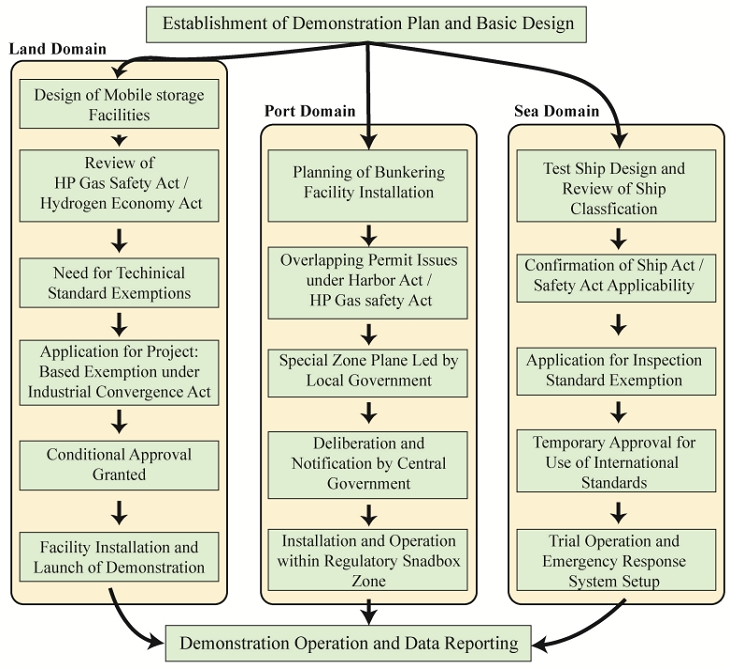
Procedural flow for applying and implementing regulatory exemptions across land, port, and maritime domains in the demonstration of liquid hydrogen test ships
5. Conclusion
This study analyzed the applicability and limitations of Korea’s current legal and institutional frameworks for enabling the real-sea demonstration of liquid hydrogen transport test ships. Due to the cryogenic and high-risk nature of liquid hydrogen, safety must be ensured across all stages, including storage, transfer, operation, and emergency response. However, existing Korean regulations are mainly designed for land-based infrastructure and conventional fuels, making them insufficient for accommodating the technical and operational characteristics of hydrogen-powered ships.
In the land domain, overlapping standards under the High-Pressure Gas Safety Control Act and the Hydrogen Economy Promotion and Safety Act create inefficiencies, as both assume fixed installations. In the port domain, the lack of explicit legal definitions for liquid hydrogen results in legal ambiguity regarding bunkering facility installation and operation. In the sea domain, while the Ship Act, Ship Safety Act, and Maritime Traffic Safety Act apply, classification, inspection, and emergency protocols tailored to liquid hydrogen vessels remain underdeveloped.
To address these issues, this study proposed applying regulatory exemption systems such as the Industrial Convergence Promotion Act (project-based) and the Regulation-Free Zone Act (zone-based), depending on the demonstration phase. Safety plans, real-time monitoring, and integrated emergency response systems must be included as approval conditions. The outcomes of these demonstrations should inform future regulatory updates.
Ultimately, legal and institutional improvements for liquid hydrogen demonstration projects require more than partial revisions. A comprehensive approach is needed, combining policy experimentation, system integration, and future-oriented regulatory design. This study provides a foundational strategy, emphasizing the need for further research on international regulatory alignment, classification standards, and multi-stakeholder governance. Successful deployment of liquid hydrogen ships will not only validate new technologies but also test the readiness of institutional systems to support a hydrogen-based maritime future.
Acknowledgments
This research was carried out in the research grant, “Demonstration of 2 K Liquefied Hydrogen carrier at sea (RS-2024-005083560)”, supported by the Ministry of Trade, Industry and Energy (MOTIE, Korea).
References
-
M. Aziz, “Liquid hydrogen: a review on liquefaction, storage, transportation, and safety”, Energies, Vol. 14, No. 18, 2021, pp. 5917.
[https://doi.org/10.3390/en14185917]

-
J. Depken, A. Dyck, L. Roß, and S. Ehlers, “Safety considerations of hydrogen application in shipping in comparison to LNG”, Energies, Vol. 15, No. 9, 2022, pp. 3250.
[https://doi.org/10.3390/en15093250]
-
Y. Jang and H. Son, “Review on domestic import and transportation of blue hydrogen produced from overseas”, Journal of the Korean Institute of Gas, Vol. 28, No. 3, 2024, pp. 10-20.
[https://doi.org/10.7842/kigas.2024.28.3.10]
-
T. Chung, “Study on business model for building hydrogen energy infrastructure at Incheon Port”, Journal of Shipping and Logistics, Vol. 39, No. 4, 2023, pp. 669-686.
[https://doi.org/10.37059/tjosal.2023.39.4.669]
-
D. Youn, S. Lee, and C. Park, “Legal issues on hydrogen bunkering through domestic law”, Journal of Hydrogen and New Energy, Vol. 33, No. 2, 2022, pp. 142-147.
[https://doi.org/10.7316/KHNES.2022.33.2.142]
-
D. Youn and C. Park, “Legal analysis and directions for implementing hydrogen bunkering in the Republic of Korea’s maritime industry”, Journal of Hydrogen and New Energy, Vol. 35, No. 4, 2024, pp. 401-409.
[https://doi.org/10.7316/JHNE.2024.35.4.401]
-
Y. Kim, D. Jang, and J. K. Kwon, “A study on the directions of the regulatory sandbox for vitalizing the hydrogen economy & industry”, The Korean Governance Review, Vol. 30, No. 1, 2023, pp. 53-80.
[https://doi.org/10.17089/kgr.2023.30.1.003]
-
J. J. Park, “A study on the system of regulatory exceptions for demonstration”, Korean Lawyers Association Journal, Vol. 70, No. 1, 2021, pp. 7-41.
[https://doi.org/10.17007/klaj.2021.70.1.001]
-
D. Youn, S. Kim, and C. Park, “Regulatory analysis and reform directions for the operational deployment of liquid hydrogen carriers”, Journal of Hydrogen and New Energy, Vol. 36, No. 2, 2025, pp. 140-149.
[https://doi.org/10.7316/JHNE.2025.36.2.140]
-
J. H. Park, “A Study on the Interpretation and Legislation of Data-Related Laws”, Journal of Intellectual Property, Vol. 17, No. 2, 2022, pp. 213-258.
[https://doi.org/10.34122/jip.2022.17.2.213]
- J. J. Park, “A legal study on the theories of regulation (II): focusing on the issue of the system coherence in the legislation for regulatory sandbox”, Korea Legislation Research Institute, Korea, 2020.
- Ministry of Trade, Industry and Energy, “High-pressure Gas Safety Control Act”, Korea Legislation Research Institute, 2021. Retrieved from https://elaw.klri.re.kr/kor_service/lawView.do?hseq=57188&lang=KOR, .
- Ministry of Trade, Industry and Energy, “Hydrogen Economy Promotion and Hydrogen Safety Management Act”, Korea Legislation Research Institute, 2022. Retrieved from https://elaw.klri.re.kr/kor_service/lawView.do?hseq=60917&lang=KOR, .
- Ministry of Oceans and Fisheries, “Harbor Act”, Korea Legislation Research Institute, 2020. Retrieved from https://elaw.klri.re.kr/kor_service/lawView.do?hseq=54512&lang=KOR, .
- Ministry of Oceans and Fisheries, “Port Authority Act”, Korean Law Information Center, 2022. Retrieved from https://www.law.go.kr/%EB%B2%95%EB%A0%B9/%ED%95%AD%EB%A7%8C%EA%B3%B5%EC%82%AC%EB%B2%95, .
- Ministry of Oceans and Fisheries, “Ship Act”, Korea Legislation Research Institute, 2018. Retrieved from https://elaw.klri.re.kr/kor_service/lawView.do?hseq=51173&lang=KOR, .
- Ministry of Oceans and Fisheries, “Ship Safety Act”, Korea Legislation Research Institute, 1993. Retrieved from https://elaw.klri.re.kr/kor_service/lawView.do?hseq=9172&lang=KOR, .
- Ministry of Oceans and Fisheries, “Maritime Traffic Safety Act”, Korean Law Information Center, 2024. Retrieved from https://www.law.go.kr/lsInfoP.do?lsiSeq=252871&efYd=20240726#0000, .